
Business cycle funds aim to optimise returns by aligning their portfolios with different phases of the economic cycle. First-time investors, those who prefer stable sector allocations, and those averse to volatility should steer clear of them.

In the broader market, the BSE Midcap was down 0.2%, while BSE Smallcap fell 0.1%.

His portfolio was worth Rs 12,333 crore at the end of June 2018. It was worth Rs 10,633 crore at the end of the September quarter. Smallcaps account for the largest number of his stock-picks. Such a fall has now happened for the third quarter in a row.

The slowdown in corporate revenue growth over the last one year has begun to reflect in India Inc's capital expenditure, or capex. The country's top listed companies are going slow on fresh investment in capacity expansion, in line with a deceleration in their top line growth. The combined fixed assets of the listed companies, excluding banking, finance services and insurance (BFSI) and the government-owned oil & gas firms, were up 10.1 per cent year-on-year (Y-o-Y) during April-September 2023 (H1FY24) - the slowest in 18 months - as against 21.1 per cent Y-o-Y growth in H2FY23 (October 2022-March 2023) and 11.6 per cent growth in the April-September 2022 period (H1FY23).

Actively-managed large-cap mutual fund (MF) schemes have managed to regain some lost sheen this year after faring poorly in the 2022 calendar year (CY22). At the end of the first six months (H1) of CY23, 78 per cent of the active large-cap schemes were ahead of the Nifty50 index funds as against just 26 per cent in 2022. When compared to the Sensex index funds, 61 per cent active funds have delivered better returns, shows an analysis of Value Research data.

Equity benchmarks began the week on a downbeat note on Monday, weighed by heavy selling in market heavyweight Reliance Industries and persisting weakness in global bourses. The rupee plunged to its lifetime low against the US dollar amid unabated foreign fund outflows, underscoring the risk-off sentiment prevailing globally as central banks embark on policy tightening to tame soaring inflation. Slipping for the second straight session, the 30-share BSE Sensex shed 364.91 points or 0.67 per cent to close at 54,470.67.

The S&P BSE Midcap and the S&P BSE Smallcap indices added 0.5% and 0.7%, respectively

Market benchmarks gave up intra-day gains to close in the red for the sixth session on the trot on Friday, capping a bruising week which saw a massive dash for safety amid rate hikes by global central banks and fears of slowing growth.

Among the Sensex constituents, 18 stocks closed in negative with UltraTech Cement, L&T, Bharti Airtel, Bajaj Finance and Tech Mahindra being major laggards. Other heavyweights like Asian Paints, Maruti, Titan and JSW Steel also saw heavy selling. In contrast, Kotak Mahindra Bank, Bajaj Finserve, HDFC Bank, ITC and SBI bucked the trend and ended the session with a gain of up to 2.09 per cent.

Among the Sensex constituents, 20 stocks ended the session in green with HDFC Bank, Titan, Tech Mahindra, and Asian Paints being the major gainers. TCS, Maruti, Kotak Mahindra Bank and Bajaj Finserve were the other gainers. In contrast, SBI, Bharti Airtel, JSW Steel, PowerGrid, ITC and Reliance closed the trading with losses.

After a sharp outperformance in the mid-and small-cap segments in the first half of calendar year 2023 (H1-CY23), analysts are now turning cautious on these two market segments and suggest investors stay selective and look for valuation comfort and earnings visibility before investing. The S&P BSE Midcap index has surged 13.7 per cent in H1-CY23, and the S&P BSE Small-cap index gained 12.7 per cent during this period, data shows. The S&P BSE Sensex, in comparison, has moved up 6.4 per cent.

A buoyant equity market, coupled with an improved performance of mutual funds (MFs) on the returns chart, has heightened retail investors' appetite for equities. In the past few months, equity MF schemes have seen a surge in fresh investments through both lump sum (one-time investments) and systematic investment plan (SIP) routes. During the August-September 2023 period, equity MF schemes recorded net lump sum investments of Rs 35,270 crore, compared to just Rs 5,550 crore in the previous three months, according to data from the Association of Mutual Funds in India (Amfi).

The last batch of quarterly earnings, global trends and trading activity of foreign investors will guide the equity market movement in a holiday-shortened week ahead, analysts said. Volatility may continue amid investors' cautious approach in the election season. Markets will remain closed on Monday due to the fifth phase of the Lok Sabha elections in Mumbai.

The S&P BSE Midcap and S&P BSE Smallcap indices hit a new lifetime high

Yes Bank was the top gainer in the Sensex pack, rallying 6.74 per cent, followed by TCS, Tata Motors, Bharti Airtel, M&M and RIL.

Analysts remain bullish on the road ahead for the equity markets, but warn against volatility on account of domestic and global cues. The upcoming Lok Sabha elections back home and the interest rate trajectory of the US Federal Reserve, they said, will be the two most important factors that the markets will keep a tab on. That apart, the valuation of the Indian markets, they feel, will also be eyed in context of how global peers are performing.

China has stayed on top for two consecutive months in the MSCI Emerging Markets Investable Market Index (EM IMI), after ceding the position to India in August. At the end of October, China's weight in the key EM gauge stood at 24.72 per cent, up from 21.58 per cent at the end of August. India's weight during this period has slipped to 20.42 per cent from 22.27 per cent.

At the BSE, 1,964 stocks declined and 871 advanced while 99 remained unchanged.

Benchmark Sensex rebounded by 167 points in a volatile trade on Friday amid buying in ICICI Bank, State Bank of India and Reliance Industries. The 30-share BSE Sensex climbed 167.06 points or 0.23 per cent to settle at 71,595.49. During the day, it hit a high of 71,676.49 and a low of 71,200.31.

The BSE Midcap and the BSE Smallcap indices pared all intraday gains to end 0.3% and 0.5% lower
As many as 267 of 453 companies from the BSE500 index are trading above their consensus price targets, according to the data compiled by Bloomberg. Not all companies in the BSE500 index are tracked by analysts.

New fund offers collection in the current calendar year was the highest in a decade, with 13 of the 70 equity schemes cornering 75 per cent of the amount raised.
From the Sensex basket, Asian Paints, Sun Pharma, HDFC Bank, Tata Consultancy Services, Axis Bank, Tata Steel, JSW Steel, Larsen & Toubro, ICICI Bank and Power Grid were the major gainers. Tata Motors dropped over 8 per cent despite reporting over three-fold jump in consolidated net profit at Rs 17,528.59 crore for the fourth quarter ended March 31, 2024. NTPC, Bharti Airtel, Titan, State Bank of India and Nestle were the other major laggards.

'Those satisfied with returns and not expecting further rally could be booking profits and also stopping SIPs.'

From the Sensex basket, Tata Consultancy Services, Nestle, Bajaj Finserv, Wipro, Maruti Suzuki India, Reliance Industries, Larsen & Toubro and NTPC were the major laggards. Tata Steel, Bajaj Finance, JSW Steel and Bharti Airtel were among the gainers.

From the Sensex basket, Tech Mahindra, Tata Steel, JSW Steel, HCL Technologies, Tata Consultancy Services, Larsen & Toubro and Kotak Mahindra Bank were the biggest laggards. Mahindra & Mahindra, Power Grid, Bajaj Finance, IndusInd Bank and Maruti were the major gainers.

Equity benchmark indices Sensex and Nifty declined for the second straight session on Friday following selling in banking, financial and select IT shares amid a weak trend in global markets. The 30-share BSE Sensex dropped by 125.65 points or 0.19 per cent to close at 66,282.74 as 16 of its constituents fell and 14 advanced. The index opened lower and fell further by around 513 points to the day's low of 65,895.41 in morning deals.
Among Sensex stocks, Wipro gained the most by 3.29 per cent. Ultratech Cement, Reliance Industries, Hindustan Unilever, Nestle, NTPC, M&M, HDFC Bank, ITC, Kotak Bank and Axis Bank were among the winners. On the other hand, HCL Tech fell the most by 1.24 per cent. SBI, TCS, Infosys, IndusInd Bank and Tata Steel also dropped.

Among the Sensex firms, Nestle rose the most by 4.66 per cent. NTPC rose by 2.16 per cent, Reliance Industries by 1.53 per cent, State Bank of India by 1.04 per cent and Hindustan Unilever by 1.03 per cent. ITC, Power Grid and Bajaj Finance were the major gainers. Wipro, Tata Consultancy Services, HCL Technologies, Tata Steel, Bajaj Finserv and Maruti were among the laggards.

While small-caps have delivered higher returns than their large-cap peers, investors would do well to recognise the incremental risk of investing in these companies.

Broader markets outperformed with BSE Midcap and BSE Smallcap adding 0.23% and 0.45%, respectively

'Over the next 12 months, it will be difficult to make 15 to 20 per cent return in the markets as the valuations appear stretched.'
The broad market depicted strength. 1,525 shares rose and 1,131 shares fell. A total of 156 shares remained unchanged
In the broader market, the S&P BSE Midcap and the S&P BSE Smallcap indices added 0.6% and 1.3%, respectively to touch their fresh lifetime highs.
The broader market outperformed with the S&P BSE Midcap down 0.3%, while the S&P BSE Smallcap was little changed.

'The Nifty index looks to be 20 per cent overvalued as per our model after moving up more than 10 per cent in the last two months.'

S&P BSE Midcap index and S&P BSE Smallcap were down 2% and 1.3% respectively

Investors became poorer by Rs 1.36 lakh crore on Friday as the markets witnessed a sell-off amid weak global trends. Benchmark stock indices Sensex tanked 671.15 points or 1.12 per cent to close at 59,135.13, as 21 of its scrips declined. The sharp decline in equities eroded Rs 1,36,037.96 crore from the market capitalisation of BSE-listed firms and that now stands at Rs 2,62,94,723.65 crore.
ICICI Bank topped the Sensex gainers' chart, spurting 5.09 per cent, followed by L&T, Bharti Airtel, Vedanta and Tata Motors, rising up to 4.60 per cent.
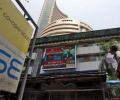
The stock markets, which had opened in the green on rate cut hopes, tumbled after the monetary policy announcement.
